Research & Publications
Peer-reviewed empirical studies, data-driven epidemiological baselines, and applied machine learning architectures bridging healthcare, agriculture, and industrial decarbonization.
Peer-Reviewed Journal Articles
Ethnoveterinary Herbal Practices Are Associated with Reduced Within-Farm Antibiotic Use and Improved Farm Performance in Commercial Poultry in Bangladesh: A Multi-District Cross-Sectional Study
Journal of Ethnopharmacology · Impact Factor: ~5.4 · CiteScore: ~9.2 · DOI: 10.1016/j.jep.2026.122316 · PMID: 42636558
Abstract: Antimicrobial resistance (AMR) in low- and middle-income country (LMIC) livestock production poses a pressing threat to global public health. This study presents a nationwide cross-sectional empirical baseline evaluating 795 commercial poultry farms across 35 districts in all 8 administrative divisions of Bangladesh. We documented 14 medicinal plant species used as ethnoveterinary remedies, led by Moringa oleifera (22.8%), Zingiber officinale (21.4%), and Citrus × limon (20.0%). Farmers implementing ethnoveterinary herbal practices reported a statistically significant 43.6% within-group reduction in antibiotic use (from 7.02 to 3.96 courses/cycle, p < 0.001), significantly lower Feed Conversion Ratios (FCR 1.970 vs 2.144, p < 0.001), and lower flock mortality (3.42% vs 5.97%, p < 0.001). Multivariable logistic regression identified peer farmer adoption (OR = 2.74, 95% CI: 1.88–4.01) and training (OR = 2.15) as prime adoption determinants, alongside a vital food safety awareness gap regarding phytochemical residues (30.2% awareness).
795
Commercial Farms
35
Districts Covered
-43.6%
Antibiotic Frequency
1.97 vs 2.14
Lower FCR Ratio
@article{nirjus2026ethnoveterinary,
  title     = {Ethnoveterinary herbal practices are associated with reduced within-farm antibiotic use and improved farm performance in commercial poultry in Bangladesh: A multi-district cross-sectional study},
  author    = {Nirjus, Jubayer Mahmud and Saha, Mousumi and Sarker, Rudra},
  journal   = {Journal of Ethnopharmacology},
  volume    = {373},
  pages     = {122316},
  year      = {2026},
  publisher = {Elsevier},
  doi       = {10.1016/j.jep.2026.122316},
  pmid      = {42636558}
}
Assistive Robotics & Healthcare Technology
Translating embedded kinematics, sensory smart gloves, and edge computer vision into low-cost assistive technologies.
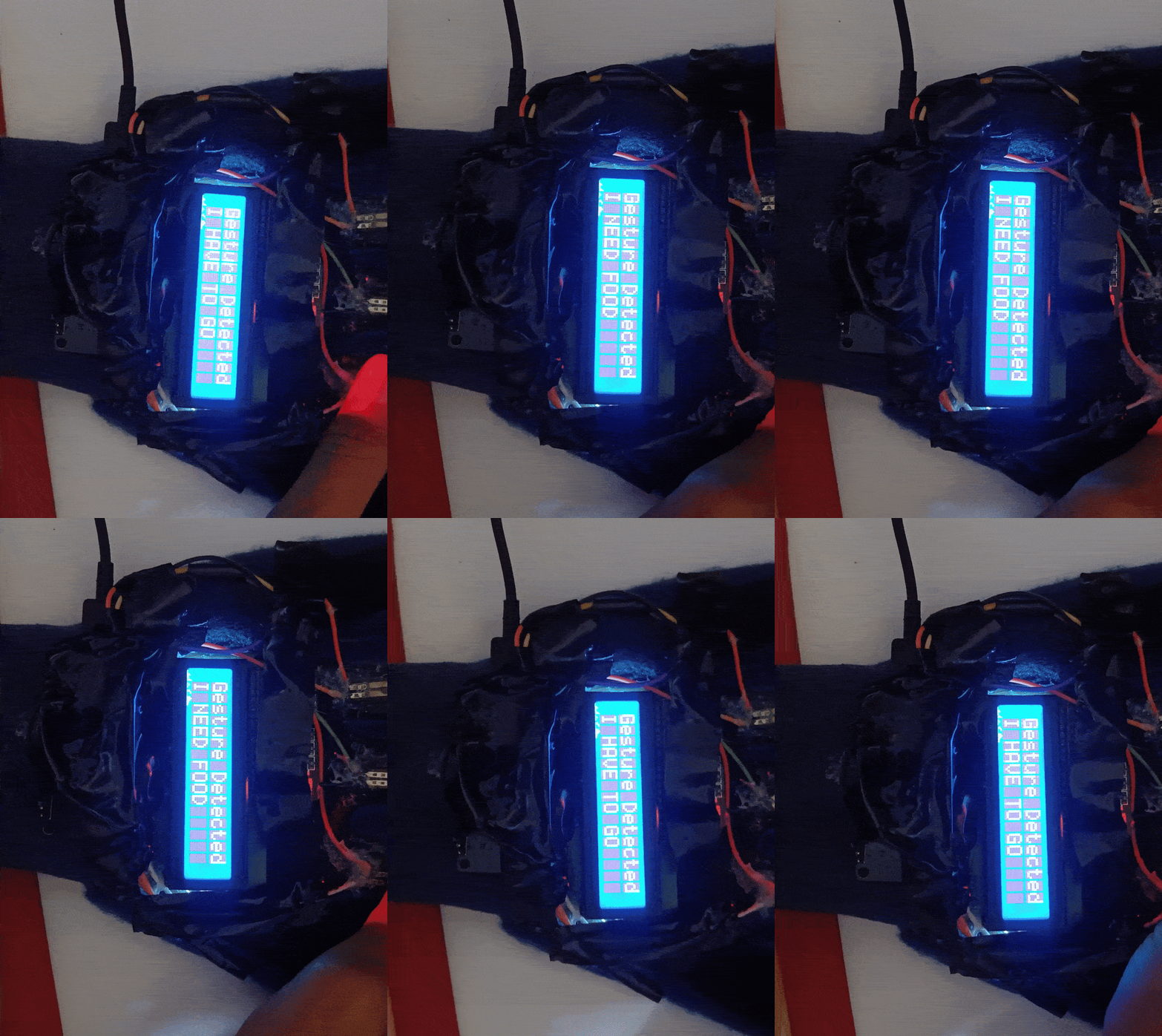
Sensory Smart Glove & Vision-Language Eyewear for Inclusive Communication
Designing wearable sensory kinematics that decode physical motion into spoken language and spatial navigation. Team SignTalk combines five bidirectional piezoresistive flex sensors and a 6-axis MPU-6050 IMU into a lightweight glove architecture, running edge ML gesture inference in <50ms. SightlineAI couples dual stereoscopic sensors with bone-conduction spatial audio feedback to provide real-time obstacle segmentation.

Academic Profiles, Identifiers & Community Repositories
Direct links to verified researcher databases, preprint repositories, competitive hackathons, and technical developer communities.